Skip to content

Know what needs you this morning, across every account.

Adintel watches every Google Ads account you manage, works out the few things that actually matter today, and shows you the reasoning behind each one. You approve. It applies. Every change is logged.

Early access. Accounts are opened by hand, a few at a time.

Briefing12 accounts, synced 07:00
  1. 1Kin & NestPMax – Core catalogue

    Conversion value down 41% week on week while spend held flat

    78% of the drop sits in one listing group. Sleep sacks took three times the impressions after the 8 Sep feed change and converted at a third of their usual rate.

    SpendPKR 48,200ValuePKR 126,400ROAS2.6 from 4.4
  2. 2Northline SupplySearch – Emergency callout

    Cost per conversion at 2.1x baseline for eight days

    One ad group has taken 62% of spend since 4 Sep. Impression share lost to rank rose to 31% across the same window, so the auction moved rather than the landing page.

    Spend$6,410CPA$184Baseline$71
  3. 3Perry Dental GroupSearch – Implants

    Capped by budget before 14:00 four days running

    Converting under target while losing a fifth of available impressions to budget. The cheapest volume on the desk this week.

    Lost IS, budget22%CPA$61Target$95

Nothing else across the other nine accounts crossed the line today.

Example briefing. Kin & Nest is our own store; the other two accounts are illustrative.
The problemAttention, not skill

You already know what to do. You just cannot get to all of it.

The morning sweep

Fourteen accounts means fourteen logins and fourteen date comparisons, and the quiet knowledge that you are checking the loud ones and skimming the rest.

The review you defer

A search term pass you know is worth doing, on every account, that has now slipped three weeks because nothing was on fire.

The first hour

A new client whose account you have an hour to understand before you have to say something intelligent about it.

None of that is a skill problem. It is an attention problem, and no dashboard has ever solved it, because a dashboard hands the triage back to you with more data attached.

How it worksFour layers, in the order they earn each other

What it does

Each layer is useful on its own, and none of them acts without you.

  1. 1The briefing

    A few things, ranked, every morning.

    Every connected account is synced nightly and scored against its own history. Adintel builds a statistical baseline per campaign, so what gets flagged is abnormal for that account rather than over a generic threshold someone picked.

    What you get is not an alert feed. It is a short list across your whole book, ordered by what is likely to cost you the most today. On a quiet morning it is short. That is the point.

  2. 2The reasoning

    Every finding tells you why it is a finding.

    A number moving is not information. What changed, where it concentrated, what moved with it, and what that probably means is information.

    Every finding carries that reasoning and the evidence behind it, written for someone who has done this for years. You can read it in fifteen seconds and disagree with it in five. That is a feature. A tool you cannot argue with is a tool you eventually stop trusting.

  3. 3Search term triage

    The review you keep deferring, done as a first pass.

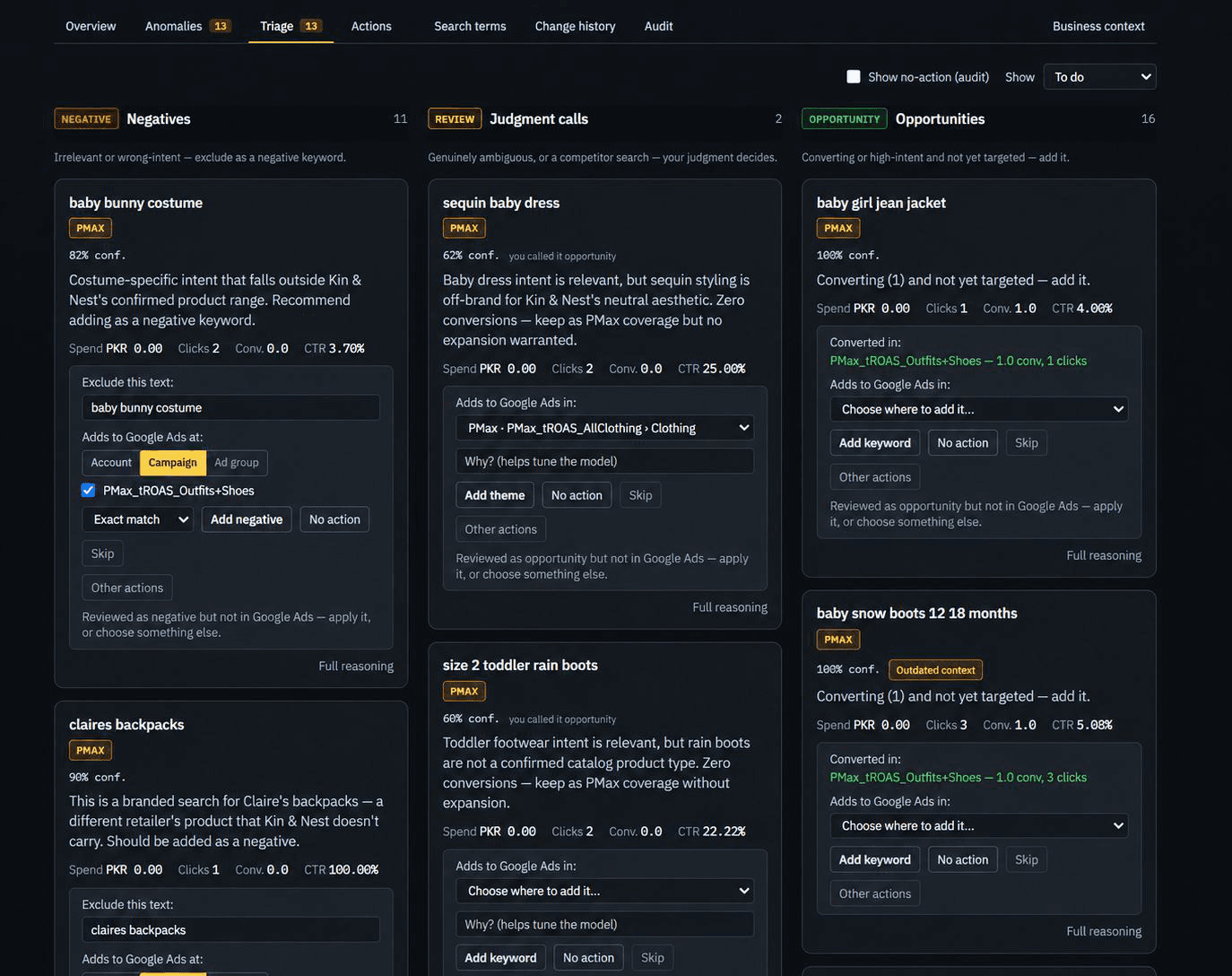
    Adintel reads the search terms across your accounts against what each client actually sells, and sorts them into clear negatives, clear keeps, and the ones that need you. Each one carries its classification, its confidence, and the reasoning, all stored so you can audit it later.

    You work the judgment column. The obvious ones you approve in bulk, and the approved negatives are written to Google for you.

  4. 4Apply, and log

    Act from here, and the client report writes itself.

    Negatives, bid adjustments, keyword and ad pauses, applied to Google from inside the tool once you approve them.

    Every applied change is recorded with its timestamp, the account and entity it touched, what changed, and what triggered it. That log is written to be read by a client, which means the monthly report becomes something you export rather than something you assemble.

  5. 5The audit

    Understand a new account before you pitch it.

    Connect any account and get a structured audit in minutes: account structure, conversion tracking, budgets, Search, Shopping, PMax, creative, search terms, product feed, audiences and targeting. Quick wins separated from the strategic work, so you know what you would fix in week one and what you would argue for in month two.

    It also tells you what it could not assess and why. An audit that quietly skips what it could not see is worse than no audit, because you will present it.

The architectureWhy this is safe to run on client money

The reasoning is explained by AI. The decisions are not.

This is the part worth being precise about, because the reasonable objection to an AI tool in this category is that you are not letting a language model spend your client’s money.

You are not. Statistical and rule-based engines decide what counts as a finding, how material it is, and where it ranks. The language model writes the explanation. It does not choose what to flag, what to recommend, or what to change.

And nothing reaches a live Google Ads account without you approving it. There is no autonomous mode, no setting to turn one on, and no plan to add one.

The differenceDecision quality, not data completeness

Most tools ask what crossed a threshold. This asks what matters.

The tools you have used were designed before software could reason in language, so they are rule engines with a dashboard in front. A rule engine can tell you that cost per conversion rose 32 percent. It cannot tell you that the rise is concentrated in one ad group, that it started the day a competitor entered the auction, and that it is the third most important thing on your desk this morning.

Forty-seven alerts is not thoroughness. It is an unpaid triage job handed back to you.

Adintel is built around one question: what would a senior practitioner do if they sat down with this account right now? Which findings exist at all, how they rank, and what counts as material are the product. That is ten years of judgment written down as software, not a threshold you configure.

FitWorth being clear about both

Who this is for

You manage somewhere between five and thirty client accounts, alone or with a small team. You are good at this, and your constraint is time rather than skill. You want a second pair of hands on the sweep and the triage, and you want to keep the judgment.

Who it is not for

Enterprise teams with dedicated analysts and a BI stack already in place. And anyone looking for hands-off automation, because the whole shape of this product assumes a skilled human approves things.

OriginBuilt for one book of business first

Built by someone who does this job

I have managed Google Ads accounts for ten years as a freelancer and small agency owner. I built Adintel because my own book had outgrown my mornings, and I ran it on my own accounts daily for a long time before letting anyone else in.

That is why it makes the choices it makes. A software company would have shipped more dashboards. I wanted fewer things to look at and better reasons to look at them.

AccessClosed, and opened by hand

Access is opening slowly, on purpose.

Adintel is in early access and signup is closed. Accounts are opened by hand, a few at a time, so that every connection gets watched properly while the onboarding path is finished.

Tell me what you manage and I will get in touch when there is room. If it is a fit, I will walk you through connecting your first account myself.

No pricing is published yet, and nobody gets billed without agreeing to a price first.

Questions
Does it change anything in my account on its own?
No. Every write to Google waits on your approval, one item at a time or in bulk, and every applied change is logged with what it touched and why.
What access does it need?
You connect through Google’s own consent flow with your Google account, the same way any Google Ads tool does. You can review what it proposes before anything is applied, and revoke access from your Google account at any time.
Can I connect accounts under an MCC?
Yes. Accounts you can reach with your Google login can be connected, including through a manager account.
How is this different from the alerts my current tool sends?
Those fire when a number crosses a threshold you set. Adintel builds a baseline per campaign from that account’s own history, ranks findings against each other, and explains each one with the evidence behind it. The output is a short ordered list, not a feed.
What does it cost?
Pricing is not set yet. Early access is free while access is closed, and no one will be charged without agreeing to a price first.
How long does it take to see anything useful?
Connecting an account pulls 90 days of history, so the first audit is available the same day. The briefing needs a few nights of syncing before its baselines are worth acting on.
Is it affiliated with Google?
No. Adintel uses the Google Ads API and is not affiliated with, endorsed by, or reviewed by Google.

Three things need you today. Adintel knows which three.

Request access

Early access. Opened by hand, a few accounts at a time.